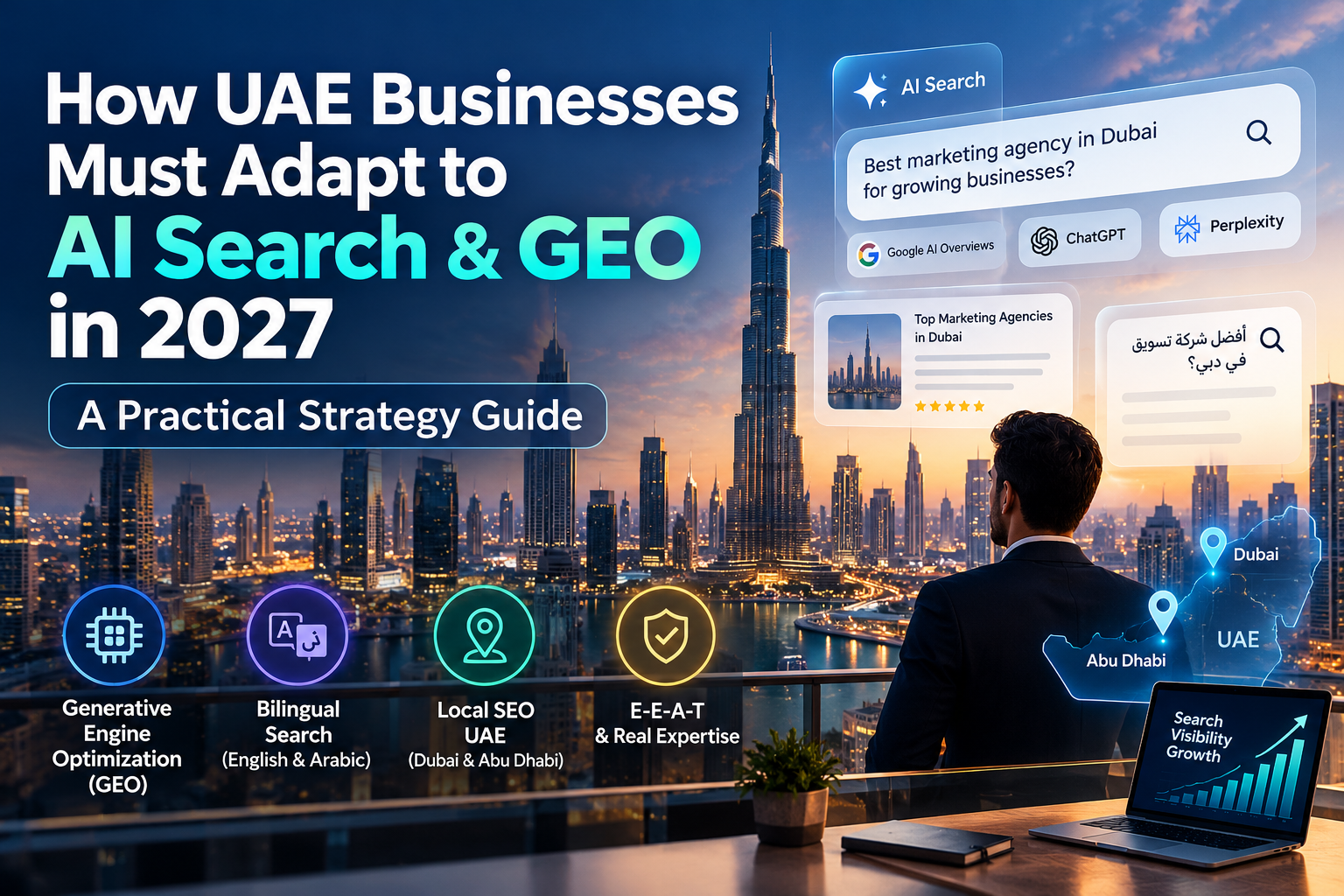
The next customer searching for your business may never visit your website before deciding whether to trust you. Instead, they may ask ChatGPT to recommend a provider, compare companies through Google AI Overviews, or use Perplexity to shortlist suppliers in Dubai.
For UAE companies preparing for 2027, this creates a major shift in digital competition. Ranking on Google remains important, but businesses must increasingly consider whether AI-powered search systems can discover, understand, verify, and recommend their services.
UAE AI search optimization 2027 is therefore becoming an important strategic consideration for business owners, CMOs, and marketing directors across Dubai, Abu Dhabi, Sharjah, and the wider Emirates.
Traditional SEO is no longer the complete picture. Companies also need to understand Generative Engine Optimization (GEO), Answer Engine Optimization (AEO), bilingual search behaviour, local search visibility, and the growing importance of original business expertise.
However, preparing for AI search does not mean abandoning established SEO practices. The strongest approach combines technical website performance, useful content, credible business information, and a customer experience that supports genuine purchasing decisions.
In this practical guide, we explain how UAE businesses can adapt their digital strategy for 2027, what matters most across emerging AI search experiences, and which actions deserve priority.
1. The Shift from Traditional SEO to GEO in the UAE
Generative Engine Optimization (GEO) helps businesses make their information clearer, more credible, and easier for AI-powered discovery systems to interpret. For UAE companies, GEO combines established SEO fundamentals, authoritative content, accurate business information, and regional relevance to strengthen visibility across traditional and AI-assisted search experiences.
For years, companies have competed for visibility through search-engine rankings. A business targeting a keyword such as "accounting services Dubai" would optimize its website, build content, improve technical performance, and attract relevant links to earn stronger organic positions.
That process remains valuable. However, AI-assisted search introduces another way for customers to discover and evaluate businesses.
Instead of searching for a short phrase, a potential customer might ask:
Example of conversational search intent: "Which accounting firms in Dubai are suitable for a growing e-commerce business that needs VAT compliance, monthly reporting, and inventory accounting?"
This question contains several signals that a traditional short keyword does not fully communicate. The customer identifies an industry, business size, location, required services, and purchasing criteria in a single request.
An AI-assisted system may respond with an explanation, evaluation criteria, and relevant sources rather than presenting only a list of websites.
For businesses, this means it is increasingly important to explain not only what services they offer, but also who those services are designed for, which problems they solve, and what evidence supports their expertise.
SEO, AEO and GEO: Understanding the Difference
| Approach | Primary Focus | Practical Application |
|---|---|---|
| SEO | Visibility in traditional search results | Technical optimization, keywords, content quality, internal links and authority. |
| AEO | Clear answers to user questions | Direct explanations, structured headings, useful summaries and question-based content. |
| GEO | Readiness for generative AI discovery | Credible information, identifiable expertise, comprehensive topic coverage and consistent business signals. |
These approaches work best as part of one connected search strategy. A website with weak technical SEO is unlikely to benefit from sophisticated content formatting if important pages cannot be discovered or indexed properly.
Similarly, a technically excellent website may struggle to communicate its commercial value if its content is generic or does not address the questions customers actually ask.
Businesses seeking a connected strategy can explore our SEO, AEO and GEO services in Dubai.
What UAE Businesses Should Do
Review your most important service pages and identify whether they clearly explain your target customers, service capabilities, industry knowledge, geographical coverage, and reasons to choose your company. Strengthen these fundamentals before investing in experimental AI-search techniques.
2. How AI Search Platforms Are Changing Business Discovery
Google Search, ChatGPT, Perplexity, and other AI-assisted platforms offer different ways for users to research products, compare services, and understand business information.
However, these platforms do not operate through identical ranking or recommendation systems. Visibility in one AI environment does not guarantee inclusion in another.
Google AI Overviews and AI Mode
Google AI Overviews can summarize information in response to eligible searches, while AI Mode provides a more conversational search experience. These features create additional ways for users to explore questions and supporting sources.
For businesses developing an AI Overviews UAE strategy, the most important starting point is understanding Google's official guidance.
According to Google Search Central's documentation on AI search features, established SEO best practices remain applicable to AI Overviews and AI Mode.
Google does not require special AI-only schema markup or a separate technical file for inclusion in these experiences.
Therefore, businesses should focus on useful, accessible, original content supported by sound website architecture and accurate information.
ChatGPT Search and Conversational Recommendations
ChatGPT can help users research solutions through conversational questions, comparisons, and searches that may incorporate information from the web.
A business owner might ask for a shortlist of website design agencies serving Dubai SMEs, then refine the request by budget, website functionality, or required integrations.
Companies should make their service descriptions specific enough to support these kinds of comparisons.
A useful business page should explain service scope, capabilities, target industries, delivery methods, and relevant commercial considerations.
Perplexity and Research-Oriented Search
Perplexity is another AI-powered research environment that can present answers supported by cited sources.
For a business publishing educational resources, this highlights the value of well-organized, original information that can be independently verified.
Original research, transparent methodologies, useful comparisons, and documented expertise provide readers with stronger reasons to trust a company's information.
Comparing Search Discovery Environments
| Platform | Customer Behaviour | Business Priority |
|---|---|---|
| Google Organic | Finding relevant websites and services | Technical SEO, intent relevance and authoritative pages |
| Google AI Features | Receiving synthesized answers and exploring sources | Helpful, well-structured and accessible information |
| ChatGPT Search | Conversational research and service comparisons | Clear capabilities, credible brand information and expertise |
| Perplexity | Researching topics through source-supported answers | Original information and verifiable sources |
| Google Maps | Finding nearby businesses and comparing options | Accurate profiles, reviews and genuine local relevance |
The commercial lesson is straightforward: businesses need a digital presence that communicates trust and relevance across multiple customer research environments.
Rather than chasing one supposedly guaranteed AI ranking technique, companies should strengthen the information that customers and search systems can use to evaluate their business.
3. English and Arabic AI Search Optimization in the UAE
Bilingual search optimization helps UAE businesses serve customers searching in English, Arabic, and mixed-language contexts. Effective localization requires more than translation. Businesses must understand regional terminology, customer intent, cultural expectations, and geographical relevance while ensuring search engines can discover the appropriate language version of important website pages.
The UAE operates within a multilingual commercial environment. English is widely used across many business sectors, while Arabic remains important for reaching relevant local audiences, organizations, and customer segments.
For companies planning UAE AI search optimization 2027, language strategy should therefore be based on actual customer demand rather than assuming that a single English-language website serves every prospective buyer.
Why Direct Translation Is Not Enough
Translating a service page word for word does not automatically create an effective Arabic search experience.
Customers may use different terminology, describe problems differently, or place greater emphasis on particular service details.
Consider a property management company serving Dubai landlords.
| English Search | Arabic Search Example | Likely Intent |
|---|---|---|
| Property management company Dubai | شركة إدارة عقارات في دبي | Find a service provider |
| Rental property management fees | رسوم إدارة العقارات المؤجرة | Understand pricing |
| Property maintenance Abu Dhabi | خدمات صيانة العقارات في أبوظبي | Find local support |
These examples demonstrate different query concepts. They should not be treated as verified search-volume trends without supporting keyword research.
How to Build a Bilingual Search Optimization Strategy
- Research both languages independently: Identify actual customer questions, preferred terminology and commercial intent in English and Arabic.
- Create dedicated language URLs: Where appropriate, maintain clear English and Arabic versions of commercially important pages.
- Implement hreflang correctly: Help Google identify equivalent language versions without confusing page indexing.
- Localize the customer experience: Adapt currencies, examples, services, forms and relevant business information.
- Use qualified Arabic review: Ensure terminology, grammar, readability and commercial meaning are appropriate for the audience.
- Support the conversion journey: Make it easy for users to submit inquiries and receive relevant assistance after reading localized content.
Google provides specific recommendations through its guidance on multilingual and multiregional websites.
Businesses should follow these technical recommendations rather than relying only on automatically translated pages.
2027 priority: Identify your most valuable Arabic-speaking customer segments first. Localize the pages that support genuine demand rather than translating the entire website without a measurable commercial objective.
4. Hyper-Local SEO in Dubai and Abu Dhabi
Hyper-local SEO helps businesses become more relevant to customers searching within specific districts, neighborhoods, and commercial areas. In the UAE, effective local optimization combines accurate business profiles, genuine service-area information, customer feedback, and useful location-specific content without creating misleading listings or large numbers of duplicated location pages.
A business targeting Dubai customers should not assume that every potential buyer across the city has the same requirements.
A corporate client operating in Business Bay may evaluate services differently from a technology company in Dubai Internet City or a logistics operator in Jebel Ali.
The same principle applies across Abu Dhabi, where commercial needs can differ between Al Maryah Island, Mussafah, Khalifa City, and other areas.
Micro-Location Targeting Opportunities
| Market | Location Examples | Potential Opportunity |
|---|---|---|
| Dubai | Business Bay, JLT, Dubai Marina | Professional services and customer-facing businesses |
| Dubai | Dubai Internet City, Dubai Silicon Oasis | Technology and B2B solutions |
| Dubai | Dubai South, Jebel Ali | Logistics, warehousing and industrial services |
| Abu Dhabi | Al Maryah Island, Al Reem Island | Corporate and professional services |
| Abu Dhabi | Mussafah, Khalifa City | Industrial, commercial and residential services |
| Sharjah | Al Majaz, Industrial Area | Local and industrial service demand |
These are examples of market segmentation rather than claims about measured search volume. Businesses should validate demand, competition, and actual service coverage before investing in dedicated location pages.
Optimize Google Business Profile for Real Customers
Google Business Profile remains important for eligible businesses that serve customers at physical locations or within genuine service areas.
According to Google's official guidance on improving local ranking, relevance, distance and prominence are important factors in local search results.
Businesses should prioritize:
- Accurate business name and contact details
- Appropriate primary and additional business categories
- Correct opening hours and service information
- Eligible business address or service-area settings
- Genuine business photographs
- Authentic customer reviews and professional responses
- Consistent service descriptions across relevant platforms
- Regular review of outdated or inaccurate profile information
Companies should never invent business locations or create misleading profiles simply to appear in more areas.
Build Location Pages That Offer Real Value
For local SEO UAE strategies, strong location pages should explain meaningful differences in services, operating coverage, customer requirements, or completed work.
A page targeting Dubai South, for example, should include relevant operational information rather than simply repeating a generic service description and changing the city name.
Where genuine evidence is available, businesses can include local case studies, service examples, and customer testimonials.
For a structured approach to Google Maps visibility and regional targeting, explore our Local Business Growth and Local SEO services.
Practical Local SEO Priority
Start with the locations where your company already serves customers successfully. Improve business information, collect legitimate customer feedback, and publish locally useful content before expanding to additional areas.
5. First-Party Proof, E-E-A-T and Real Human Expertise
E-E-A-T represents experience, expertise, authoritativeness, and trustworthiness. Businesses demonstrate these qualities through original research, credible authors, documented results, transparent methodologies, and accurate information. Although E-E-A-T is not a standalone ranking score, its principles support useful, trustworthy content that customers can evaluate with confidence.
Artificial intelligence has made content production faster and more accessible. Companies can generate articles, service descriptions, and marketing materials with far less manual effort than before.
However, the ability to publish more content does not automatically create greater authority.
In a market saturated with similar explanations, original experience can become a meaningful competitive advantage.
Why Generic AI Content Is Not Enough
Imagine two digital marketing agencies serving businesses in Dubai.
The first agency publishes broad advice about SEO, social media, advertising, and lead generation. Its articles describe familiar recommendations without presenting any distinctive experience.
The second agency publishes an original analysis of a marketing campaign, explaining the commercial problem, changes implemented, measurement process, and observed performance.
The second example gives readers stronger evidence with which to evaluate the agency's competence.
It does not guarantee AI citations or higher rankings, but it creates a more useful and credible informational asset.
What Google Says About E-E-A-T
Google's guidance on helpful, reliable, people-first content encourages creators to provide original information, demonstrate relevant experience, and make content useful for its intended audience.
For UAE businesses, this means replacing unsupported marketing claims with evidence that customers can evaluate.
Seven Ways to Demonstrate Genuine Expertise
- Publish original case studies: Explain customer challenges, solutions, measurement methods and verified outcomes.
- Identify qualified contributors: Show who writes or reviews specialist content and why their expertise is relevant.
- Share authentic customer feedback: Use legitimate testimonials with appropriate permissions.
- Document your methodology: Explain how your team assesses needs, delivers services and evaluates results.
- Produce original research: Share useful findings from legitimate business data where appropriate and permitted.
- Demonstrate actual work: Use genuine project examples, processes, photographs or product demonstrations.
- Maintain transparent business information: Provide clear service details, contact information and relevant credentials.
Turn Broad Claims Into Evidence-Based Content
A statement such as "we deliver the best SEO results in Dubai" gives a prospective customer little useful information.
A stronger approach would explain how an agency evaluates technical problems, prioritizes commercial keywords, improves landing pages, and measures qualified leads.
If verified results are available, the business can publish the measurement period, baseline, observed change, and relevant limitations.
Key takeaway: In a competitive AI search environment, credibility should be demonstrated rather than declared. Original experience, transparent information, and relevant evidence help customers distinguish capable businesses from generic content publishers.
6. Building a Strong GEO Content Strategy for UAE Businesses
Generative Engine Optimization Dubai strategies should begin with the questions customers ask when evaluating business solutions.
Rather than building an editorial calendar around unrelated high-volume keywords, marketing teams should organize content according to customer problems, commercial intent, and the expertise the business can genuinely demonstrate.
Build Topic Clusters Around Commercial Services
Consider a UAE logistics company offering fulfillment services to online retailers.
Its core service page might target e-commerce fulfillment in Dubai.
Supporting content could address:
- How fulfillment costs are calculated in the UAE
- Common challenges in last-mile delivery
- How to evaluate warehouse providers in Dubai
- Order processing and inventory management requirements
- Cross-border fulfillment considerations for UAE sellers
- Operational questions to ask before signing a fulfillment agreement
Each supporting article should provide genuinely useful information and link naturally to the relevant commercial page.
This approach creates a stronger information architecture and helps customers progress from research to purchasing decisions.
Use Answer-First Content Structure
When a section addresses a specific business question, provide a concise answer near the beginning.
Then expand with examples, practical considerations, comparisons, and appropriate supporting evidence.
Useful content structure can include:
- Clear H2 and H3 headings
- Direct answers to relevant questions
- Short explanatory paragraphs
- Tables where comparisons improve understanding
- Actionable recommendations
- Original examples and supporting evidence
- Descriptive internal links
Answer Engine Optimization does not require every paragraph to follow one rigid format. Content should remain natural and genuinely helpful to readers.
Connect Informational Content With Business Outcomes
A blog article may attract readers who are researching a problem but are not yet ready to purchase.
Its purpose should be to help those readers understand the issue and identify their next logical step.
For example, a guide about improving UAE website conversion rates can link to a relevant digital marketing service page rather than forcing a sales message into every paragraph.
Businesses building broader acquisition strategies can explore our Digital Marketing services for UAE businesses.
The objective is not merely to generate visitors. It is to connect useful information with appropriate commercial opportunities.
7. Technical SEO and AI Search Readiness for 2027
Strong content cannot compensate for every technical website problem.
Search engines and AI-assisted discovery systems depend on accessible information. If important pages are blocked, incorrectly canonicalized, poorly linked, or inaccessible, their discoverability may be limited.
Review Website Crawlability and Indexing
Businesses should verify that important commercial pages are available to relevant search crawlers and eligible for indexing where applicable.
Key areas to review include:
- Robots.txt configuration
- XML sitemaps
- Canonical URLs
- Incorrect noindex directives
- Broken internal links
- Redirect chains
- Mobile usability
- Page rendering and accessibility
These are established SEO fundamentals, but they remain important as search interfaces evolve.
Use Structured Data Correctly
Appropriate structured data can help search engines understand information such as business identity, page type, services, articles and other supported entities.
However, structured data should accurately reflect visible content.
Adding unsupported schema properties, fabricated reviews, or irrelevant markup is not a credible GEO strategy.
Businesses should also understand that schema markup does not guarantee inclusion in AI-generated answers.
Improve Website Speed and Conversion Experience
A technically accessible website must also provide a satisfactory experience for potential customers.
Review mobile page usability, content readability, navigation clarity, contact forms, and the steps required to request a quotation.
Businesses often focus on visibility while overlooking what happens after a visitor arrives.
An effective UAE AI search optimization 2027 strategy should connect discovery with conversion rather than treating website traffic as the final objective.
8. UAE AI Search Optimization 2027: Actionable Business Checklist
UAE businesses should prepare for 2027 by improving technical SEO, strengthening service pages, publishing original evidence, maintaining accurate local information, and identifying relevant bilingual search opportunities. They should also test AI search visibility using consistent prompts and connect marketing performance with qualified inquiries, customer acquisition, and revenue.
Preparing for AI-powered discovery should follow a clear implementation sequence.
The checklist below covers the foundations businesses should assess before expanding investment in GEO.
Technical SEO Checklist
- Verify indexing of high-priority service pages.
- Fix important crawlability and canonicalization problems.
- Review internal linking and website architecture.
- Improve mobile usability and page performance.
- Validate relevant structured data.
Content and GEO Checklist
- Identify commercial customer questions for each service.
- Rewrite generic content with more specific information.
- Use accurate, concise explanations under relevant headings.
- Publish genuine expert insights and original examples.
- Develop topic clusters linked to commercial pages.
- Maintain credible sources and current information.
UAE Localization Checklist
- Audit Google Business Profile information.
- Confirm genuine business and service-area details.
- Research location-specific search opportunities.
- Identify relevant Arabic-language customer segments.
- Provide properly localized pages where justified.
- Ensure consistent brand information across platforms.
Measurement Checklist
- Record baseline organic traffic and conversions.
- Track qualified inquiries and acquisition sources.
- Monitor identifiable AI referral traffic where possible.
- Create a repeatable AI-search testing process.
- Review branded search demand and local performance.
- Measure business outcomes, not mentions alone.
Implementation advice: Do not attempt to improve everything simultaneously. Prioritize the website pages, services, and customer segments with the strongest commercial potential.
9. A Practical 90-Day GEO Implementation Roadmap
A structured roadmap helps UAE companies move from understanding AI search to making measurable improvements.
The following 90-day plan can be adapted to businesses of different sizes.
Days 1 to 30: Audit and Prioritize
Start by evaluating current organic search performance, technical SEO, service-page content, local search visibility, language requirements, and conversion tracking.
Identify the highest-value commercial pages and document the questions potential customers ask when evaluating your services.
Test a defined selection of relevant queries in AI-assisted platforms to establish an initial visibility baseline.
Expected deliverable: A prioritized technical, content, local SEO and GEO action plan.
Days 31 to 60: Improve Content and Authority
Update the most important service pages with clearer explanations, stronger internal linking, useful customer information and evidence-backed expertise.
Publish carefully researched supporting resources that answer commercially meaningful questions.
Improve local business information and develop relevant Arabic-language experiences where customer demand supports them.
Expected deliverable: Stronger commercial content, improved information architecture, and credible supporting assets.
Days 61 to 90: Measure, Refine and Expand
Review changes in visibility, customer engagement, qualified inquiries, and conversion performance.
Repeat defined AI search tests, assess identifiable referral traffic, and compare outcomes against the original baseline.
Expand useful content into additional priority topics only after reviewing initial performance and customer needs.
Expected deliverable: A documented ongoing SEO and GEO growth roadmap for 2027.
The timeline is an implementation framework rather than a promise of rankings or AI citations within 90 days.
Meaningful organic improvements can require additional time depending on competition, existing website quality, and search-engine processing.
10. Measuring AI Search Visibility and Real Business Results
One of the biggest challenges with Generative Engine Optimization is determining whether activity produces commercial value.
A brand appearing in an AI-generated response may be encouraging, but a single mention does not establish sustained visibility or revenue contribution.
AI-generated answers can vary depending on query wording, available sources, platform behaviour, location, and other contextual factors.
Businesses should therefore combine AI visibility testing with established marketing and sales measurements.
Key GEO and SEO Performance Indicators
| KPI | What It Measures | Why It Matters |
|---|---|---|
| Organic Qualified Leads | Relevant inquiries from organic search | Commercial demand generation |
| Organic Conversion Rate | Visitors completing valuable actions | Website effectiveness |
| AI Referral Traffic | Identifiable visits from AI platforms | Emerging acquisition activity |
| AI Citation Frequency | Brand appearances in a defined query test set | Directional visibility monitoring |
| Local Search Actions | Relevant interactions from local search | Regional business interest |
| Lead-to-Customer Rate | Qualified leads becoming customers | Sales and revenue effectiveness |
How to Conduct Practical AI Visibility Tests
Create a documented collection of questions reflecting genuine customer purchasing intent.
For example, a marketing agency might test queries concerning SEO providers in Dubai, local search services for UAE retailers, or website optimization for Abu Dhabi businesses.
Use consistent query wording, record the platform and testing date, and document whether the brand is mentioned or its website is cited.
Repeat tests over time and look for patterns rather than treating individual responses as definitive evidence.
These tests should supplement, not replace, website analytics, Search Console data, CRM records, and customer acquisition reporting.
The commercial priority should remain the same: improving the quantity and quality of business opportunities generated through digital channels.
11. Common GEO Mistakes UAE Businesses Must Avoid
Interest in AI-powered search has created opportunities for legitimate innovation, but it has also encouraged unrealistic claims and ineffective optimization shortcuts.
Businesses preparing for 2027 should avoid the following mistakes.
Mistake 1: Believing GEO Replaces SEO
AI search optimization still depends heavily on clear, accessible and credible information.
Abandoning technical SEO, helpful content, internal linking, or local optimization is unlikely to strengthen a business's search foundations.
Mistake 2: Publishing Large Volumes of Generic AI Content
Producing dozens of similar articles without original expertise or editorial review can weaken content quality and create unnecessary maintenance work.
Use AI tools to assist productivity while keeping human judgment central to research, accuracy, customer relevance and quality control.
Mistake 3: Translating Arabic Pages Without Localization
Direct translation does not guarantee local search relevance.
Businesses should validate terminology, user intent and conversion experiences for Arabic-speaking audiences.
Mistake 4: Creating Duplicate Location Pages
Publishing near-identical pages for every Dubai or Abu Dhabi neighborhood can produce little value for customers.
Create separate pages only when meaningful local information supports them.
Mistake 5: Treating AI Mentions as Guaranteed Revenue
Visibility matters, but businesses should measure whether their digital strategy contributes to qualified leads, customer acquisition and long-term commercial value.
Mistake 6: Following Unverified AI Ranking Tricks
No single keyword-density formula, schema property, or special paragraph format can guarantee inclusion in AI-generated recommendations.
Organizations should rely on credible search guidance, practical testing, and continuous improvement rather than unsupported promises.
The Better Approach for UAE Brands
Invest in discoverable content, genuine expertise, reliable business information, locally relevant customer experiences, and measurable search performance. These foundations provide value across traditional search and emerging AI-assisted discovery environments.
12. Final Thoughts: Prepare Your UAE Business for AI Search in 2027
The shift toward AI-powered search is changing how customers investigate solutions, compare providers, and develop confidence in businesses.
For UAE companies, the challenge extends beyond traditional keyword rankings. Businesses must consider how clearly their expertise, service capabilities, geographical relevance, and credibility are communicated across digital platforms.
Successful UAE AI search optimization 2027 will require a balanced strategy that combines proven SEO fundamentals with the practical principles of GEO and AEO.
That means improving website accessibility, building useful content around customer questions, supporting important claims with genuine evidence, and creating relevant search experiences for English- and Arabic-speaking audiences.
It also means recognizing that AI search technology will continue evolving. No agency can guarantee permanent inclusion in AI-generated answers or recommendations.
The most sustainable opportunity is to build a credible, well-organized online presence that makes it easier for potential customers to understand and evaluate your business.
In 2027, competitive search visibility will be about more than appearing in results. It will be about helping customers recognize your business as a relevant, trustworthy choice.
Is Your UAE Business Ready for AI Search in 2027?
Your business may already rank for important keywords, but are your services clearly positioned for Google AI Overviews, conversational search and emerging AI-powered discovery?
At Tariq Global Ventures, we help businesses across Dubai, Abu Dhabi and the UAE improve digital visibility through SEO, AEO, GEO-focused content strategy, local SEO and conversion-oriented marketing.
Our approach connects search optimization with business objectives, helping companies strengthen their digital foundations and develop better opportunities for qualified customer inquiries.
Discuss your SEO, AEO and GEO strategy with our team.
Contact Tariq Global Ventures for an SEO and GEO consultation
Editorial note: This guide reflects search guidance and digital marketing developments available as of October 2026. Recommendations for 2027 are strategic preparations, not guarantees of future platform behaviour or search results.
Frequently Asked Questions About AI Search & GEO in the UAE
As AI-powered search transforms how customers discover and compare businesses, UAE companies need clarity on what GEO means, how it differs from traditional SEO, and where to invest for 2027. These answers address the most important commercial questions for business owners and marketing decision-makers.
What is Generative Engine Optimization (GEO), and why does my UAE business need it in 2027?
Generative Engine Optimization (GEO) focuses on making your business information easier for AI-powered search platforms, including Google AI Overviews, ChatGPT, and Perplexity, to discover, understand, and potentially reference.
For UAE businesses, GEO is becoming important because customers increasingly use conversational searches to compare providers and evaluate services.
A strong GEO strategy helps position your business for these discovery experiences while supporting traditional SEO. However, no optimization strategy can guarantee AI recommendations.
Can my business appear in ChatGPT and Google AI Overviews without ranking first on Google?
Yes. A business does not necessarily need to rank in Google's first organic position to appear in AI-generated search experiences.
AI search systems use different methods to retrieve and present information. However, having an accessible website, clearly described services, accurate business information, and credible supporting content can strengthen your overall search presence.
Businesses should focus on becoming trustworthy and relevant sources rather than pursuing a guaranteed AI ranking position.
Should UAE businesses invest in GEO or traditional SEO first?
For most UAE businesses, traditional SEO should provide the foundation, while GEO should be integrated into the wider search strategy.
If your website has indexing problems, weak service pages, poor mobile performance, or limited local visibility, those issues should receive priority.
Once these fundamentals are addressed, GEO-focused improvements such as answer-first content, original research, expert-led resources, and stronger brand information can support broader search discovery.
The objective is not to choose SEO or GEO, but to make them work together.
Do I need Arabic-language content to compete in AI search across Dubai and Abu Dhabi?
Not every UAE business needs a fully bilingual website. The decision should depend on your target customers and their search behavior.
If Arabic-speaking customers represent an important commercial audience, professionally localized Arabic content can help you reach them more effectively.
A successful bilingual strategy includes relevant Arabic search terminology, dedicated language pages, accurate translations, and an appropriate customer inquiry experience.
Businesses targeting primarily English-speaking B2B audiences may achieve better initial returns by improving their existing English content before expanding into Arabic.
How much does GEO cost in Dubai, and how long does it take to see results?
GEO costs in Dubai depend on website size, technical condition, competition, content requirements, bilingual optimization, and the scope of ongoing work.
A smaller service business may begin with a focused technical audit and optimization of its main commercial pages. A larger organization may require multilingual content development, original research, authority-building, and ongoing AI visibility monitoring.
A 90-day implementation plan can establish strong foundations, but there is no guaranteed timeline for appearing in AI-generated answers.
Businesses should evaluate progress through technical improvements, organic visibility, qualified leads, and measurable commercial outcomes rather than relying only on AI mentions.