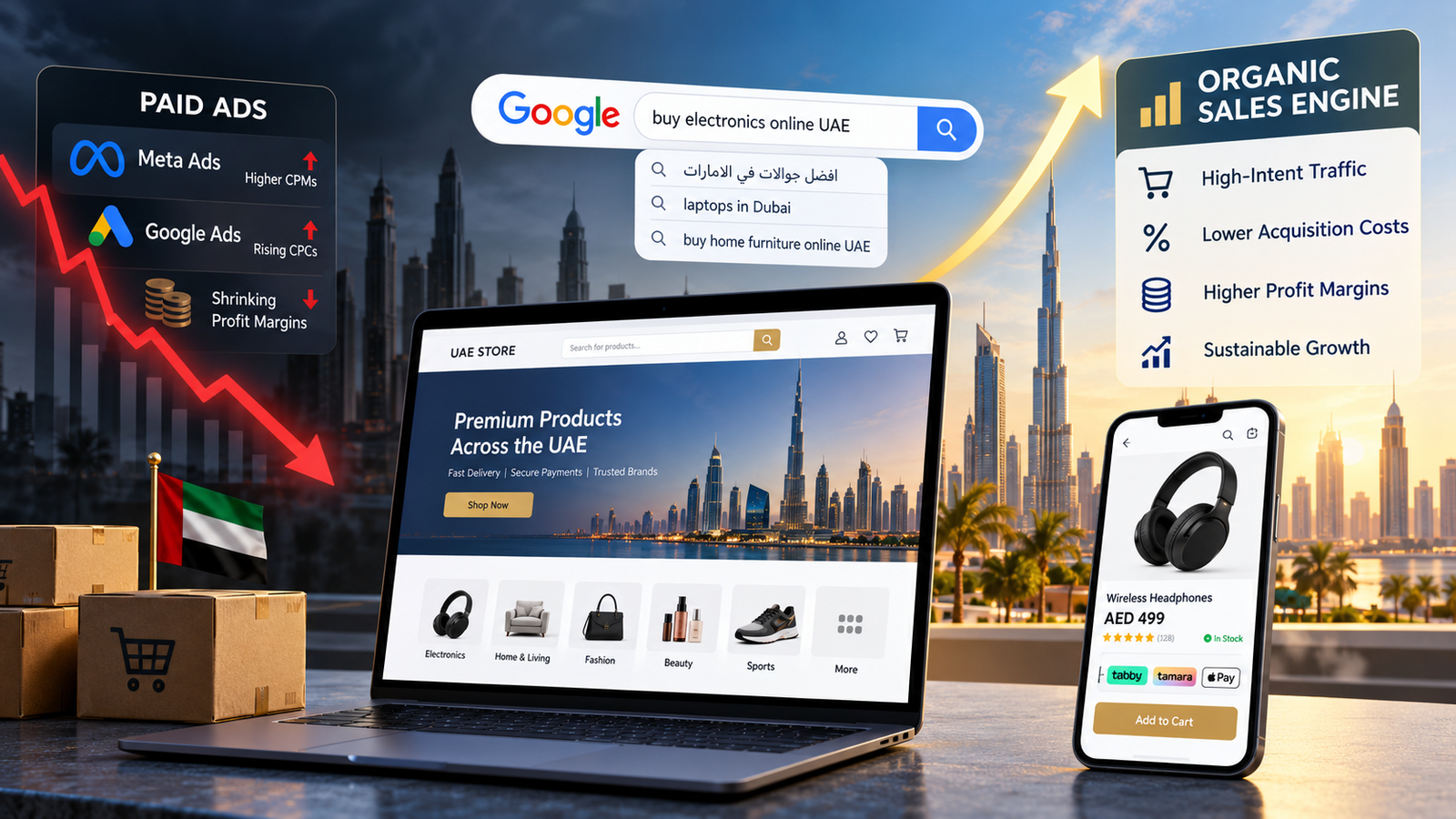
E-commerce SEO in UAE is becoming a critical margin-protection strategy for online retailers that rely heavily on Meta and Google Ads. When customer acquisition costs increase, profitable growth depends on capturing high-intent organic shoppers, converting them efficiently, and reducing the amount spent acquiring every new customer.
For online stores operating in Dubai, Abu Dhabi, Sharjah, and other UAE markets, advertising can generate immediate demand, but rising acquisition costs, promotional discounts, payment fees, and delivery expenses can quickly reduce the margin remaining after a sale.
The solution is not to abandon paid advertising. It is to build a high-converting organic sales engine that captures existing purchase intent, converts shoppers efficiently, and gradually reduces the proportion of revenue dependent on paid acquisition.
This requires a commercial SEO strategy built around profitable product categories, localized buying behavior, mobile performance, and measurable transaction value.
1. The Paid Ad Trap in the UAE: Why Margins Are Shrinking
Competition for commercial audiences across Dubai, Abu Dhabi, Sharjah, and the wider Gulf can make paid acquisition expensive. When CPMs and CPCs increase, retailers must either improve conversion economics or accept a lower contribution margin.
The underlying problem is exposure to auction pricing. A store relying entirely on paid traffic must repeatedly purchase visibility, even for products with established market demand.
The Real Cost of a Paid Order
Consider a UAE retailer with an AED 300 order value. Its simplified unit economics might look like this:
| Cost Component | Illustrative Amount |
|---|---|
| Order revenue | AED 300 |
| Product cost | AED 120 |
| Delivery and packaging | AED 20 |
| Payment processing | AED 10 |
| Discount | AED 20 |
| Paid customer acquisition | AED 85 |
| Contribution remaining | AED 45 |
These figures are hypothetical and assume an AED 300 order before the illustrated discount. They exclude other operating costs and potential returns.
If acquisition cost increases from AED 85 to AED 110, the contribution falls from AED 45 to AED 20. Revenue may remain stable while profit deteriorates.
Strategic principle: E-commerce SEO in UAE should be treated as a margin-protection strategy, not simply another traffic channel. Organic visibility is not free, but its marginal acquisition cost can decline as profitable product categories earn stronger search positions.
Measure organic performance using contribution profit after fulfillment, discounts, transaction costs, returns, and attributable SEO investment. Avoid treating last-click organic revenue as automatically incremental, particularly when branded searches originate from earlier paid campaigns.
2. Intent-First Keyword Architecture for E-commerce SEO in UAE
A profitable SEO strategy begins with the products customers are ready to purchase, not the informational topics likely to attract the largest search volumes.
Prioritize queries containing commercial modifiers such as price, buy, delivery, online, specific brands, sizes, and product specifications.
Build Categories Around Purchase Intent
For example, a UAE furniture retailer might organize its catalog around the following hierarchy:
- Main category: Office Chairs UAE
- Commercial subcategory: Ergonomic Office Chairs Dubai
- Specific buying intent: Mesh Office Chairs with Lumbar Support
- Product page: Individual chair model with price, availability, specifications, and delivery details
Each level serves a different purchasing decision. Category pages help buyers compare available products, while product pages support specific transactions.
Avoid creating multiple near-identical landing pages targeting minor keyword variations. Every indexable category should have distinct inventory, search intent, and commercial value.
Account for English and Arabic Buying Behavior
UAE shoppers search in English, Arabic, and sometimes mixed-language combinations. The same customer might research a product in Arabic, compare English-language brand specifications, and complete a purchase through an English checkout.
Successful e-commerce SEO in UAE requires understanding these differences rather than assuming that every English keyword has an equally valuable Arabic translation.
Analyze search demand separately by language. Arabic terms should be researched using natural local phrasing rather than direct translations of English keywords.
- Create distinct English and Arabic URLs when both language experiences are genuinely supported.
- Use accurate translations of product specifications, delivery information, and commercial policies.
- Implement reciprocal hreflang annotations for corresponding language pages.
- Keep canonical tags consistent with the intended indexable language versions.
- Avoid targeting identical buyer intent through competing pages within the same language.
Translated pages are not automatically penalized as duplicate content. The practical risk is poor localization, incorrect language targeting, or unnecessary overlap that fragments search signals.
Prioritize Keywords by Commercial Value
Score opportunities using search intent, expected conversion rate, gross margin, inventory availability, and ranking feasibility.
A low-volume search for a high-margin product can be more valuable than a broad category term that attracts thousands of visitors with limited buying intent.
3. High-Converting Product and Category Page Optimization
Getting a product indexed is only the beginning. Its page must answer the questions that prevent a customer from completing the purchase.
An effective e-commerce SEO in UAE strategy connects transactional search visibility with on-page conversion improvements. Higher rankings provide limited financial value when visitors abandon product pages before adding anything to their carts.
Make Transactional Information Immediately Visible
Every important product page should clearly present:
- Specific product name, brand, model, and relevant specifications.
- Accurate AED pricing and applicable VAT information.
- Current stock status and variant availability.
- Expected delivery coverage across relevant UAE emirates.
- Payment options and installment eligibility.
- Return conditions, warranty details, and authentic customer reviews.
On mobile, the price, main product image, variant selection, and purchase action should appear before lengthy marketing descriptions. Place secondary specifications in accessible expandable sections.
Use Product Structured Data Correctly
Google's Product structured data guidance explains how merchants can make prices, availability, reviews, and other product attributes eligible for richer search presentations.
For UAE stores, validate:
- Product: Name, image, description, SKU, and brand.
- Offer: Current selling price with priceCurrency set to AED.
- Availability: Accurate InStock, OutOfStock, or another supported status.
- AggregateRating: Genuine, visible customer rating information where available.
- Merchant information: Applicable shipping, delivery, and return details.
Never generate artificial ratings or publish schema values that contradict visible product information. Synchronize structured data with inventory and pricing updates.
Validate templates using Google's Rich Results Test. Correct markup improves machine readability but does not guarantee enhanced search results.
Optimize Visual Content Without Sacrificing Speed
Compress product images into suitable modern formats such as WebP or AVIF, provide responsive image sizes, and reserve space to prevent layout movement.
Use original photography where possible. Show multiple angles, meaningful scale references, and short demonstrations for products where functionality influences purchase decisions.
Prioritize the main product image for fast loading. Lazy-load below-the-fold media rather than delaying the primary visual that shoppers need immediately.
Conversion opportunity: A product page with clear AED pricing, credible imagery, accurate availability, and transparent delivery information can reduce uncertainty before checkout. Evaluate improvements through add-to-cart rate, checkout progression, and completed orders.
4. Localized Trust Signals That Turn Organic Clicks Into Orders
UAE consumers may discover an unfamiliar retailer through Google, but search visibility alone does not establish sufficient confidence to purchase.
Trust must be demonstrated through payment flexibility, reliable fulfillment expectations, authentic business information, and accessible customer support.
Show Relevant UAE Payment Options Early
Depending on merchant eligibility, product category, and gateway support, useful options include:
- Tabby and Tamara: Buy-now-pay-later options for eligible purchases and shoppers.
- Apple Pay: A convenient wallet checkout option for supported devices and gateways.
- Local payment gateways: Secure card processing with appropriate AED settlement support.
- Cash on delivery: An option to evaluate for suitable products and delivery locations, taking refusal and return-to-origin costs into account.
Merchants can review the official Tabby and Tamara websites for availability and integration requirements.
Do not display a payment method unless it is actually available. Installment messaging should reflect current provider terms, customer eligibility, and the product's final payable amount.
Reduce Delivery and Return Uncertainty
Display delivery expectations at the product or cart level, distinguishing Dubai, Abu Dhabi, Sharjah, and other service areas where fulfillment schedules differ.
Make return windows, excluded product categories, refund processing, shipping charges, and warranty coverage easy to locate before checkout.
If cash on delivery is offered, monitor failed delivery attempts and returned shipments separately. A higher checkout conversion rate is not necessarily more profitable when fulfillment losses rise.
Establish a Verifiable Local Business Identity
Publish accurate company contact details, customer service availability, and relevant business credentials. Where applicable, implement Organization or LocalBusiness structured data that reflects the real entity and its physical presence.
Do not invent an office address or create a local business listing solely for rankings. Accurate business information supports customer confidence and consistency across search surfaces.
For stores requiring improvements to the customer journey, payment integration, and commercial structure, explore TGV's E-commerce Solutions in UAE.
5. The Technical Foundation: Speed, Mobile and Site Architecture
Technical SEO should support product discovery and completed purchases. For UAE stores serving a predominantly smartphone-oriented audience, mobile friction can undermine both organic visibility and conversion efficiency.
Technical performance is an essential component of e-commerce SEO in UAE because even commercially relevant organic traffic can fail to generate revenue when product pages load slowly, filters create confusion, or checkout interactions become difficult.
Measure Mobile Performance on Revenue-Critical Pages
Start with your highest-revenue category, top product templates, and checkout entry points. Use field data rather than relying exclusively on laboratory performance scores.
Google's Core Web Vitals guidance recommends:
- LCP: 2.5 seconds or less for loading performance.
- INP: 200 milliseconds or less for responsiveness.
- CLS: 0.1 or less for visual stability.
Assess these thresholds at the 75th percentile of real page visits, with mobile performance evaluated separately.
Remove unnecessary scripts, limit intrusive popups, reserve image dimensions, and reduce heavyweight third-party applications.
Control Faceted Navigation and Duplicate URLs
Filters for brand, size, color, price, and availability can generate enormous numbers of overlapping URLs.
Google's faceted navigation guidance explains how uncontrolled filters consume crawling resources and delay discovery of valuable pages.
Apply a deliberate indexing policy:
- Keep commercially valuable categories crawlable, indexable, and internally linked.
- Create dedicated landing pages for filtered combinations with demonstrable search demand.
- Use consistent canonical URLs for equivalent or duplicate content.
- Prevent unnecessary crawling of parameter combinations when they provide no search value.
- Keep internal links, XML sitemaps, and indexable canonical URLs aligned.
Remember that robots.txt disallow rules prevent crawling, while noindex directives require a crawler to access the page. Do not assume both controls can be applied together to achieve deindexing.
Platform-Specific Priorities
| Platform | Priority Technical Checks |
|---|---|
| Shopify | Theme performance, duplicate product routes, collection linking, app scripts, and structured data accuracy. |
| Magento / Adobe Commerce | Layered navigation, indexation controls, cache configuration, product variants, and catalog scalability. |
| WooCommerce | Hosting performance, plugin overhead, variable products, category archives, caching, and schema conflicts. |
Regardless of platform, ensure important product pages are accessible through ordinary crawlable internal links and are not dependent entirely on search boxes or JavaScript interactions.
Build a Revenue-Based SEO Reporting System
Connect Google Search Console, GA4 e-commerce events, and order-level financial reporting.
Review organic revenue alongside the metrics that explain whether it is profitable:
- Organic conversion rate and revenue per organic session.
- Contribution margin from organic-attributed orders.
- Non-branded organic transactions and new-customer orders.
- Product-level add-to-cart and checkout completion rates.
- Return, cancellation, and failed-delivery rates.
- SEO investment relative to incremental contribution profit.
Separate branded demand, repeat customers, and first-time purchases wherever data allows. Use a consistent attribution model and avoid equating platform-reported revenue with fully incremental sales.
A Practical 30-Day Execution Sequence
- Week 1: Identify ten high-margin products or categories with proven demand and measurable conversion gaps.
- Week 2: Correct transactional intent targeting, internal linking, titles, product specifications, and structured data.
- Week 3: Improve mobile product pages, checkout friction, local payment visibility, and delivery transparency.
- Week 4: Evaluate indexing, organic transactions, conversion rates, and contribution profit against the baseline.
Expand only after the initial categories demonstrate measurable progress. Organic growth compounds through repeatable improvements, not simply higher publishing volume.
6. Final Thoughts: Build Revenue Beyond Paid Ads
E-commerce SEO in UAE offers online retailers a practical way to reduce paid advertising dependency while protecting contribution margins. Begin by auditing your ten highest-margin product categories against organic purchase intent, mobile conversion performance, and actual profitability.
Fix the pages with the strongest commercial opportunity first, then reinvest measured gains into a repeatable search and conversion program that builds profitable organic revenue over time.
Businesses seeking to connect technical search optimization with commercial outcomes can explore TGV's SEO, AEO & GEO services and Digital Marketing solutions.
Frequently Asked Questions About E-commerce SEO in UAE
Find practical answers to common questions about reducing advertising costs, increasing organic sales, improving conversion rates, and building a more profitable online store in the UAE.
Can an online store in the UAE generate consistent sales without spending heavily on Google or Meta Ads?
Yes. An established online store can generate consistent sales through organic search when its product and category pages target purchase-ready customers.
However, SEO takes time to build momentum. The most effective approach is to gradually reduce paid advertising dependency while developing organic visibility for high-margin products.
How long does e-commerce SEO in UAE take to generate actual sales?
Some established stores may see improvements within 2–3 months after fixing technical and product-page issues. Competitive categories often require 6–12 months of sustained work. Results depend on existing domain authority, competition, inventory, and website quality.
Track organic transactions and contribution profit rather than rankings alone.
Is investing in SEO more profitable than running paid advertisements for a UAE online store?
SEO can deliver better long-term acquisition economics, particularly for products with consistent search demand. Unlike paid advertising, organic visibility does not require paying for every click.
However, SEO still involves investment in technical improvements, content, and maintenance. Profitability should be assessed by comparing contribution profit after acquisition costs across both channels.
Should UAE e-commerce stores optimize for Arabic keywords, English keywords, or both?
Both languages can be valuable, but the priority depends on the target customers and product categories. English may perform strongly for some international brands, while Arabic can capture additional local buying intent.
Stores should analyze actual demand and conversion performance in each language before investing in dedicated localized product and category pages.
Why is my UAE online store receiving organic traffic but not generating enough orders?
Common reasons include visitors arriving through informational rather than transactional searches, slow mobile product pages, unclear delivery costs, limited payment options, insufficient customer reviews, and complicated checkout processes.
Review the entire shopping journey from landing page to completed purchase before increasing your SEO investment.
What should a UAE online store fix first to increase organic sales?
Start with your highest-margin product categories that already receive search impressions but generate limited transactions.
Review keyword intent, product availability, AED pricing, page speed, payment options, and checkout abandonment. Improving these existing revenue opportunities is often more commercially valuable than publishing additional informational blog posts.