A website redesign can make a business look more modern, but appearance alone is not a good reason to rebuild a website. For a Dubai business, a successful redesign should improve how quickly customers understand the company, how easily they find the right service, how confidently they trust the brand, and how often website visits turn into enquiries.
That is why website redesign in Dubai should be treated as a business, marketing, SEO and conversion project, not simply a graphic design exercise.
A redesigned website can improve performance dramatically, but a poorly planned relaunch can also remove valuable pages, break internal links, change URLs, weaken existing Google rankings, disconnect tracking or make conversion paths harder rather than easier.
The objective is not to ask, “How can we make the website look newer?” The more important question is: “How can the redesigned website become a stronger source of visibility, trust and qualified enquiries?”
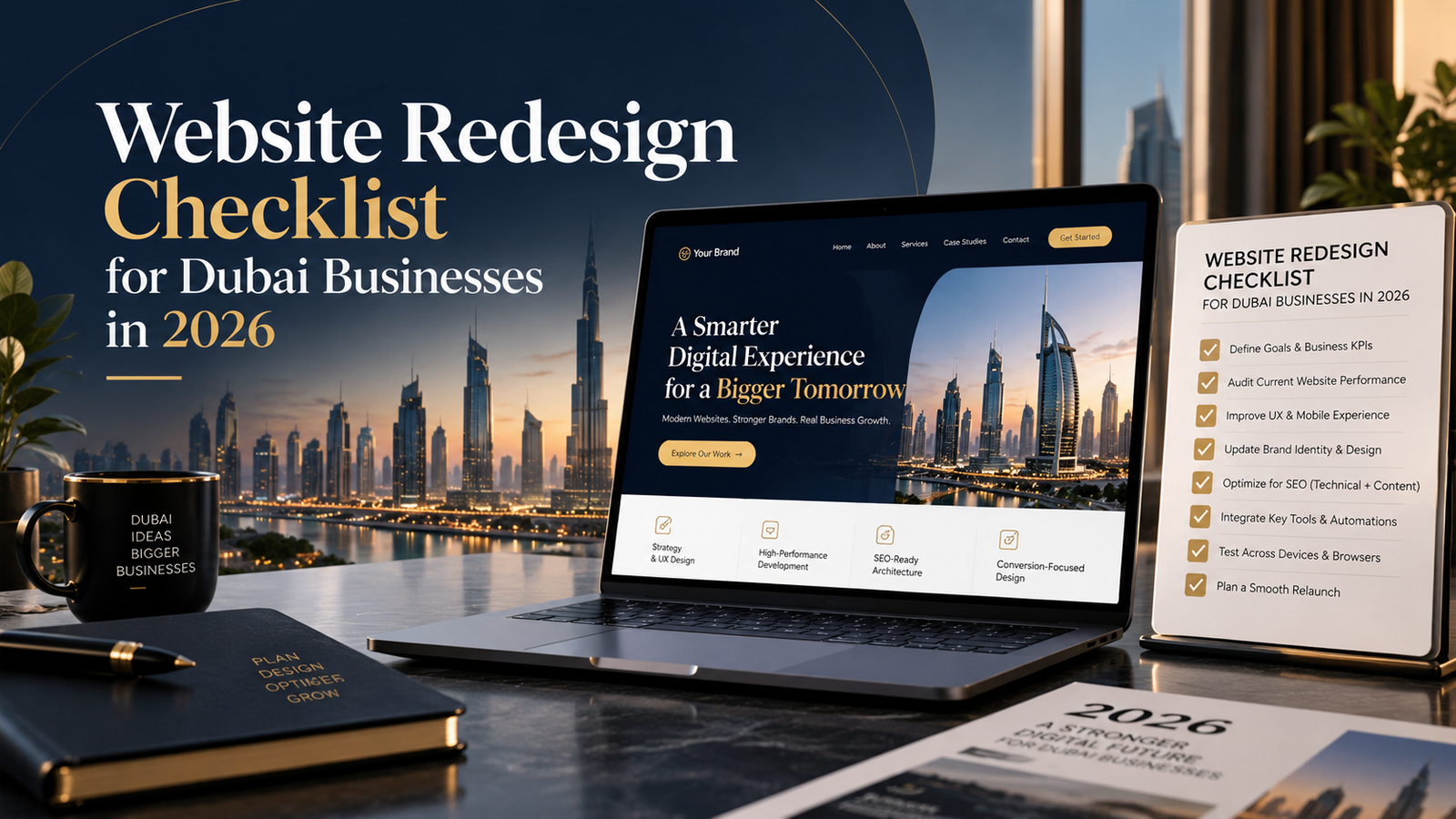
This 21-point website redesign checklist explains what Dubai businesses should review before redesigning, during development and immediately before relaunching a website in 2026.
Quick Answer: What Should a Website Redesign Actually Improve?
A strong website redesign in Dubai should improve five things together: business positioning, user experience, mobile performance, search visibility and conversion performance. If the new website only looks better but does not make it easier for the right customer to discover, understand, trust and contact your business, the redesign has not solved the most important problem.
Table of Contents
- Why Dubai Businesses Redesign Websites
- 1. Define the Business Goal
- 2. Audit the Existing Website
- 3. Protect Valuable Pages
- 4. Rebuild Around Customer Intent
- 5. Improve Website Architecture
- 6. Strengthen Service Pages
- 7. Design Mobile First
- 8. Improve Website Speed
- 9. Strengthen Trust Signals
- 10. Improve Calls to Action
- 11. Simplify Enquiry Forms
- 12. Plan WhatsApp Conversion Paths
- 13. Preserve and Improve SEO
- 14. Map URL Redirects
- 15. Rebuild Internal Linking
- 16. Strengthen Dubai Relevance
- 17. Prepare for AEO and GEO
- 18. Set Up Tracking Correctly
- 19. Test Before Launch
- 20. Monitor Search After Relaunch
- 21. Keep Improving After Launch
- Pre-Launch Checklist
- Final Thoughts
Why Dubai Businesses Redesign Websites
Dubai is a competitive market. Customers frequently compare several companies before making contact, particularly when buying professional services, home services, B2B solutions, technology, real estate services, healthcare services or higher-value products.
That comparison often happens before the customer ever speaks to a salesperson.
Your website may therefore be responsible for answering some of the prospect's first questions:
- Does this company actually provide what I need?
- Does it operate in Dubai or my part of the UAE?
- Does the business look professional and credible?
- Can I understand the service without searching through several pages?
- Why should I choose this company instead of a competitor?
- How easily can I call, WhatsApp or submit an enquiry?
If an outdated website creates friction at any of those stages, redesigning it can have a direct commercial purpose. A well-planned website redesign in Dubai gives a business the opportunity to improve both presentation and performance at the same time.
Businesses planning a full rebuild can also review TGV's Website Design services in Dubai, which include website redesign, mobile-responsive development, lead forms, WhatsApp integration and search-ready website structure.
The key principle: redesign the website around the buying journey, not around what happens to look fashionable in 2026.
Website Redesign Checklist for Dubai Businesses: 21 Things to Fix
Define What the Redesigned Website Must Achieve
Do not begin with colours, animations or templates. Begin with the business outcome.
Different websites have different jobs. A law firm may prioritize consultation requests. A property company may prioritize viewing enquiries. A B2B service provider may need qualified lead forms. A local company may rely heavily on calls and WhatsApp conversations.
Before beginning a website redesign in Dubai, decide exactly what success should look like after the new website goes live.
- More qualified enquiries
- More calls or WhatsApp conversations
- Higher organic search visibility
- Better conversion from Google Ads traffic
- Improved local visibility in Dubai
- More online sales
- Better presentation of high-value services
- Stronger brand credibility
These objectives should influence navigation, content, landing pages, design, calls to action and analytics.
Audit the Existing Website Before Replacing It
An existing website contains data. Do not throw that information away simply because the visual design is old.
Before redesigning, document what currently works and what does not.
- Which pages receive organic traffic?
- Which pages generate enquiries?
- Which keywords currently rank?
- Which pages have backlinks?
- Where do visitors leave the website?
- Which pages are slow?
- Which forms or buttons receive engagement?
- Which pages receive almost no traffic?
Google Search Console, analytics data and existing lead records can provide a better foundation for redesign decisions than personal preference alone.
Identify Pages You Cannot Afford to Lose
One of the most expensive redesign mistakes is deleting pages that already attract relevant search traffic.
A page may look outdated while still having substantial SEO value. The solution may be to redesign and improve that page, not remove it.
This is especially important during a website redesign in Dubai, where established pages may already be competing for valuable commercial search terms.
Before changing the website structure, create an inventory containing the current URL, traffic, rankings, backlinks, conversions and planned action for every important page.
Build the New Website Around Customer Intent
Business owners understand their company from the inside. Customers do not.
Visitors should not need to understand your internal department structure, corporate terminology or organizational hierarchy to find what they need.
Organize the website around the questions and actions customers actually have:
- What do you offer?
- Is this service suitable for me?
- Do you serve my location?
- How does the service work?
- Why should I trust you?
- How do I get started?
This customer-led approach also creates a stronger foundation for SEO because individual pages can target clearly defined search intent.
Simplify the Website Architecture
A redesign is an opportunity to remove unnecessary complexity.
Customers should be able to move logically between the homepage, service pages, supporting information and contact options without repeatedly returning to the main navigation.
A service business might use a structure such as:
Home > Services > Individual Service > Supporting Content > Contact / Enquiry
Supporting blog posts should then link naturally into relevant commercial pages rather than existing as isolated articles.
Give Important Services Their Own Strong Pages
One generic “Services” page is often insufficient when a business sells several distinct solutions.
Individual service pages allow the website to explain each offer in greater depth and align each page with a specific customer need.
A strong service page can address:
- The customer problem
- The service being offered
- What is included
- How the process works
- Who the service is for
- Commercial benefits
- Reasons to trust the provider
- Frequently raised objections
- The next action the visitor should take
TGV applies this approach across services such as SEO, AEO and GEO, Lead Generation and Local Business Growth.
Design the Mobile Experience First
Mobile responsiveness is no longer an optional adjustment made after the desktop design has been completed.
Every important page should be reviewed on smaller screens for:
- Readable text
- Comfortable spacing
- Simple menus
- Tap-friendly buttons
- Fast-loading images
- Short forms
- Clear calls to action
- Usable WhatsApp and phone links
A professional website redesign in Dubai should make the mobile experience at least as strong as the desktop experience, because many potential customers will first visit the website from a phone.
Improve Speed Instead of Adding Unnecessary Design Weight
Website redesigns often become slower because developers add oversized images, multiple font files, video backgrounds, animation libraries, sliders and third-party scripts.
A modern website should feel faster, not heavier.
Review image compression, caching, hosting, JavaScript, CSS, fonts, video assets and third-party tools. Google's PageSpeed Insights can be used to examine performance, while Google's Core Web Vitals guidance explains important user-experience performance measurements.
Do not optimize for a perfect score at the expense of the business. The practical objective is a fast, stable, usable website that delivers the required functionality without unnecessary technical weight.
Build Trust Into the Website Instead of Assuming It
Customers are unlikely to enquire simply because a website has attractive colours.
Credibility should be visible throughout the customer journey.
- Clear company information
- Professional service explanations
- Authentic reviews or testimonials where available
- Relevant portfolio work or case studies
- Accurate contact information
- Transparent processes
- Privacy and policy pages
- Consistent branding
- Real business credentials where relevant
Avoid filling pages with unsupported superlatives such as “#1”, “best” or “leading” unless you can substantiate those claims.
Give Every Important Page a Clear Next Step
A prospective customer should never reach the end of a high-intent page and wonder what to do next.
Calls to action should reflect the service and buying stage. Depending on the business, that may mean:
- Request a consultation
- Get a quotation
- Book an appointment
- Call the business
- Start a WhatsApp conversation
- Request an assessment
- Submit project requirements
Strong conversion design is not about covering every section with buttons. It is about placing the right action where the visitor is likely to need it.
Remove Unnecessary Friction From Enquiry Forms
Every required field asks the visitor for additional effort.
Only request information the business genuinely needs at that stage of the customer journey. A first enquiry rarely requires a long questionnaire.
Also test what happens after submission. Confirm that:
- The form sends successfully
- The business receives the enquiry
- The customer receives an appropriate confirmation
- Spam protection works
- Mobile users can complete the form comfortably
- Conversions are recorded in analytics
Plan WhatsApp as a Conversion Channel
For many UAE businesses, WhatsApp is an important customer communication channel.
During redesign, treat it as part of the conversion journey rather than simply adding a floating icon.
Make sure the correct number is used, links work on desktop and mobile, the button does not cover important content, and the user understands what will happen after clicking.
Where appropriate, pre-filled messages can also help customers state which service they are interested in.
Protect SEO During the Website Redesign
SEO should be part of redesign planning from the beginning rather than added after the new site is finished.
For any website redesign in Dubai, preserving existing search visibility should be one of the core technical requirements.
Review:
- SEO titles and meta descriptions
- Heading structure
- Existing ranking content
- Image ALT text
- Canonical tags
- Indexability
- XML sitemap
- Robots directives
- Structured data
- Internal links
- Page speed
- URL structure
Businesses that want the redesign and search strategy developed together can review TGV's SEO, AEO and GEO services.
Create a Redirect Map Before Any URL Changes
If an existing URL changes, the old address should normally redirect to the most relevant replacement page using an appropriate permanent redirect.
Do not redirect every removed page blindly to the homepage.
Create a spreadsheet containing:
Old URL > New URL > Redirect Required > Tested
Google's documentation on site moves with URL changes explains the importance of mapping old URLs to their new destinations and monitoring the transition.
Rebuild Internal Links Intentionally
Redesigning navigation is only part of website architecture. Contextual internal links inside page content are also important.
They help users move between related topics and help search engines understand relationships between pages.
For example, an article about acquiring customers can naturally link to a Lead Generation service page, while an article about local visibility may link to Local Business Growth services.
After redesign, crawl the website for links that still point to outdated URLs or unnecessary redirects.
Strengthen Dubai and UAE Relevance Where It Is Genuine
A business serving Dubai should make that geographic relevance understandable without stuffing “Dubai” unnaturally into every sentence.
A carefully planned website redesign in Dubai should improve local relevance through useful business information and location-focused content rather than repetitive keyword placement.
Useful local signals can include:
- Accurate service-area information
- Dubai-specific service content
- Consistent contact information
- Google Business Profile information where applicable
- Local testimonials or projects where genuinely available
- Location-relevant supporting content
For companies competing for map and local search visibility, TGV's Local Business Growth services focus on Google Business Profile optimization, local search foundations and location-focused visibility.
Prepare the New Website for Search, Answer Engines and AI Discovery
Website content in 2026 should be built for people first, but it should also be structured clearly enough for search systems to understand what the business does, which services it provides and how different topics relate to one another.
That means using:
- Clear service definitions
- Logical headings
- Direct answers to common customer questions
- Strong topical coverage
- Consistent business information
- Useful internal links
- Relevant structured data
- Original, specific content instead of generic filler
Google's guidance for AI features in Search continues to emphasize standard SEO fundamentals rather than requiring a completely separate technical system for AI search visibility.
Set Up Conversion Tracking Before the New Site Goes Live
A redesign cannot be judged properly if the business cannot measure what happens afterward.
Decide which actions matter commercially and track them.
- Form submissions
- Phone clicks
- WhatsApp clicks
- Appointment bookings
- Quote requests
- Purchases
- Important landing-page actions
This allows the business to compare the redesigned website against the old website using actual outcomes rather than visual preference.
Test the Website Like a Customer Before Launch
Do not limit pre-launch testing to asking whether pages “look okay.”
Complete real customer journeys.
- Find a specific service from the homepage
- Open the website on different phones
- Submit every important form
- Test telephone links
- Test WhatsApp links
- Check desktop and tablet layouts
- Test menus and dropdowns
- Review spelling and contact details
- Check all internal and external links
- Test 404 pages
- Check redirects
- Review indexing settings
Ideally, someone who did not build the website should also test it. Developers and business owners often know where everything is located and therefore miss navigation problems that are obvious to a first-time visitor.
Monitor Google Search Console After Relaunch
The redesign project does not end when the new website becomes public.
After launch, monitor Google Search Console for indexing problems, crawl errors, page visibility and search-performance changes.
Also submit the correct XML sitemap and inspect particularly important URLs where necessary.
Businesses completing a website redesign in Dubai should monitor important pages closely during the first few weeks after launch to make sure indexing and search visibility remain stable.
Treat Launch as the Beginning of Optimization
No redesign gets every decision perfect on launch day.
Once real customers begin using the new website, the business gains better information about what should happen next.
Review:
- Which pages attract organic traffic?
- Which pages generate qualified enquiries?
- Which CTAs receive engagement?
- Where are visitors abandoning forms?
- Which pages have weak conversion rates?
- Which search queries are creating new opportunities?
- Which services require stronger supporting content?
Website redesign should move the business into an improvement cycle rather than creating another website that remains unchanged for the next five years.
What Should Be Preserved, Improved or Removed?
One of the easiest ways to manage a redesign is to classify every important element of the existing website into three categories.
| Decision | Typical Examples | Recommended Approach |
|---|---|---|
| Preserve | Ranking pages, valuable URLs, backlinks, high-converting content | Keep the value while improving presentation and usability |
| Improve | Weak service content, slow pages, outdated layouts, poor navigation | Redesign around user intent, search visibility and conversion |
| Remove or Consolidate | Duplicate pages, obsolete information, thin content, unused sections | Consolidate carefully and redirect old URLs where appropriate |
Website Redesign Should Improve the Entire Customer Journey
Before the Visit
SEO, local search, advertising and content should bring the right audience to the right landing page.
During the Visit
Clear messaging, usability, trust and useful content should help visitors make a decision.
After the Enquiry
Forms, WhatsApp, CRM systems and follow-up processes should move genuine prospects toward the next stage.
This is why website development should not be separated completely from marketing strategy. A website is the destination for many SEO, advertising, social media and lead-generation activities.
A website redesign in Dubai should therefore connect traffic acquisition with conversion. SEO can help people discover the website, but clear service pages, strong offers and simple enquiry paths are what help turn that visibility into business opportunities.
For example, businesses investing in Lead Generation need landing pages capable of converting the traffic those campaigns create. Likewise, stronger SEO visibility has limited commercial value if visitors arrive at pages that do not explain the offer or provide a compelling next step.
Website Redesign Pre-Launch Checklist
Before replacing the existing website, complete one final review.
SEO & Website Structure
- Important existing URLs have been reviewed.
- Changed URLs have appropriate redirects.
- SEO titles and meta descriptions are complete.
- Heading structures are logical.
- Canonical settings have been checked.
- XML sitemap is available.
- Indexing settings are correct.
- Important internal links work.
- No staging-site noindex settings remain accidentally active.
Performance & User Experience
- Desktop layouts have been tested.
- Mobile layouts have been tested.
- Tablet layouts have been checked.
- Images are compressed appropriately.
- Navigation works correctly.
- No important content is hidden or overlapping.
- Page-speed issues have been reviewed.
Lead Generation & Conversion
- Contact forms have been tested.
- Form emails reach the correct inbox.
- WhatsApp links open correctly.
- Phone links work on mobile.
- Calls to action lead to the intended destination.
- Conversion tracking is configured.
- Confirmation messages or thank-you pages work.
Business & Compliance
- Contact details are accurate.
- Company information is consistent.
- Privacy Policy is accessible.
- Terms and applicable policies are accessible.
- Cookie and data-handling requirements have been reviewed where applicable.
Businesses handling personal information should also ensure that their website and data collection processes reflect applicable requirements. The UAE Government provides information regarding UAE data protection laws.
When Does a Dubai Business Actually Need a Redesign?
A redesign makes sense when the current website is creating a measurable limitation rather than simply because a competitor has launched something newer.
A business may need a website redesign in Dubai when its current website no longer supports the way customers search, compare services or make enquiries.
Common warning signs include:
- The website no longer reflects the company's actual services.
- Mobile usability is poor.
- Pages load slowly.
- Navigation has become confusing.
- Customers struggle to understand the offer.
- Enquiries are weak despite reasonable traffic.
- The website cannot support current SEO strategy.
- The design damages brand credibility.
- Updating content is unnecessarily difficult.
- The company has outgrown the original website structure.
- Important marketing campaigns require better landing pages.
Businesses still planning their website investment may also find our guide on how much a website costs in Dubai useful when comparing the scope of a redesign with a complete rebuild.
Do Not Redesign a Website Just to Make It Look Different
Visual design matters. Customers notice inconsistent typography, outdated layouts, poor image quality and unprofessional presentation.
But the strongest redesign decisions solve more than aesthetic problems.
Changing a colour palette may improve appearance. Rebuilding an unclear service hierarchy may improve sales. Replacing a decorative homepage with a clearer value proposition may improve both user experience and conversion. Preserving a ranking URL may protect years of accumulated organic visibility.
Those decisions have different commercial value.
A better redesign question: Instead of asking “Does this section look modern?”, ask “What should the visitor understand, feel or do after seeing this section?”
How Website Redesign Connects With Lead Generation
Traffic and conversion should not be treated as separate problems.
SEO can increase search visibility. Google Ads can generate immediate traffic. Social media can increase awareness. Local search can help nearby customers discover a company. Once someone reaches the website, the website itself becomes part of the sales process.
This is where a strategic website redesign in Dubai can make a measurable difference. The redesigned site should help turn incoming traffic into calls, WhatsApp conversations, quote requests and qualified enquiries.
A redesigned website should therefore support:
- Landing pages aligned with campaign intent
- Strong commercial service pages
- Clear offers
- Simple lead capture
- Conversion tracking
- Fast follow-up pathways
For businesses working specifically on customer acquisition, our guide to generating high-quality leads in Dubai explains additional strategies for attracting and converting prospects.
Final Thoughts
A successful website redesign in Dubai should create a stronger business asset, not simply a newer-looking website.
The best redesign projects start with evidence: existing rankings, customer behaviour, business objectives, service priorities, technical performance and conversion data. Design decisions are then made around those priorities.
That means preserving valuable SEO equity, improving service architecture, strengthening mobile usability, removing conversion friction, creating better local relevance, preparing content for evolving search experiences and ensuring every major customer journey works before the new website goes live.
A business that follows this approach is far less likely to finish a redesign with a beautiful website that produces exactly the same commercial results as the old one.
Instead, the redesign becomes an opportunity to connect website design, SEO, customer experience and lead generation into one stronger digital platform.
For companies considering website redesign in Dubai, the most important decision is not which visual style to choose. It is how the new website will support visibility, trust, conversion and long-term business growth.
Planning to Redesign Your Business Website?
Tariq Global Ventures helps businesses in Dubai and across the UAE redesign outdated websites into faster, clearer and more conversion-focused digital platforms. Our approach combines professional website design with mobile usability, SEO-ready architecture, lead-generation pathways and long-term growth considerations.
Explore Website Design ServicesFrequently Asked Questions About Website Redesign in Dubai
Planning a website redesign often raises important questions about SEO, cost, timelines, existing rankings, and whether a full rebuild is even necessary. These FAQs address the practical concerns Dubai business owners should understand before investing in a new website.
Will redesigning my website hurt my Google rankings?
It can, if the redesign is handled incorrectly. Rankings can drop when valuable pages are deleted, URLs are changed without proper redirects, internal links are broken, content is reduced, or technical SEO settings are missed.
A professional redesign should preserve important URLs, map redirects, retain high-performing content, check indexing settings, and monitor Google Search Console after launch.
How do I know whether I need a website redesign or just a few updates?
If your website still has a strong structure, good mobile performance, clear service pages, and working conversion paths, targeted improvements may be enough.
A full redesign makes more sense when the site is difficult to navigate, outdated on mobile, slow, poorly structured for SEO, weak at generating enquiries, or no longer reflects your current services and brand positioning.
How long does a website redesign usually take for a Dubai business?
The timeline depends on the size of the website, number of service pages, content requirements, technical integrations, approval process, and whether SEO migration is involved.
A small business website may take a few weeks, while a larger redesign with SEO restructuring, custom functionality, and multiple service pages can take considerably longer.
The important point is to avoid rushing the launch before redirects, forms, tracking, mobile layouts, and SEO settings are fully tested.
Should I keep my current website live while the new one is being built?
Yes. In most cases, the existing website should remain live while the new version is developed on a staging environment.
This avoids unnecessary downtime and allows the new website to be tested properly before launch.
The staging version should also be blocked from search engine indexing so it does not create duplicate content issues.
What should I prepare before hiring someone to redesign my website?
Prepare your current website data, list of services, target customers, priority locations, branding assets, access to analytics and Google Search Console, examples of competitors you like or dislike, and a clear idea of what you want the new website to achieve.
It is also useful to identify which pages currently generate traffic or enquiries so those assets are not accidentally lost during the redesign.
How can I tell whether a redesigned website is actually better than the old one?
Do not judge the redesign only by appearance. Compare measurable business results such as organic traffic, rankings, conversion rate, number of enquiries, WhatsApp clicks, phone calls, form submissions, page speed, mobile usability, and user engagement.
A successful redesign should improve the customer journey and business performance, not simply make the website look newer.